
Product pages often serve as the final decision-making touchpoint. Faced with the challenge of converting undecided users, many product teams lean heavily on persuasive, stylistic language to compel action. While this “marketing copy” can be effective in moderation, its overuse poses a serious risk: it diminishes user trust, conceals essential product details, and ultimately undermines conversion potential.
Shoppers today are increasingly skeptical and information-driven. When browsing online, they are not just skimming for inspiration; they are actively evaluating whether a product meets a specific set of functional, technical, or aesthetic needs. If the product description is saturated with inflated language and superlatives but lacks specificity, users may feel manipulated rather than informed. In turn, this diminishes the perceived credibility of even legitimate claims, such as performance metrics or endorsements, which may be dismissed as exaggerated or unreliable.
For product managers and e-commerce leaders, this tension between persuasion and clarity is strategic. The way a product is described directly impacts user perception, decision-making confidence, and trust in the brand. This article examines the UX and behavioral implications of excessive marketing copy, outlines content strategies to improve product description clarity, and provides concrete, research-backed recommendations for writing high-converting product content that informs rather than overwhelms.
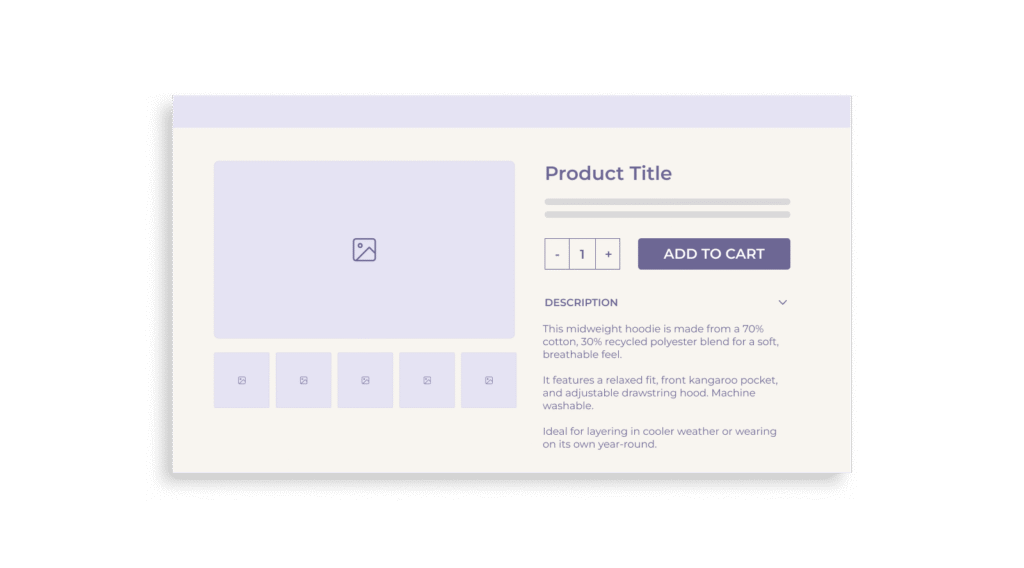
UX & Behavioral Risks of Excessive Marketing Copy
Shoppers navigating e-commerce platforms are typically focused on finding specific answers: Does this product fit my needs? Is it compatible with my current setup? Can it meet my performance expectations? When product descriptions lean too heavily on stylized or persuasive language, users often struggle to identify the information that directly supports their purchasing criteria. This creates unnecessary friction at a critical moment in the decision-making process.
Observational user research has consistently shown that shoppers tend to skim product descriptions rather than read them word-for-word. When the content is saturated with glowing adjectives or conceptual appeals, users are forced to mentally filter out what they perceive as noise to find factual details. Over time, this filtering effort not only slows down the evaluation process but also cultivates a sense of doubt. Even when concrete claims do appear later (such as certifications, measurements, or scientific validations), they may be received with skepticism because the user is already on alert for exaggerated messaging.
This sensitivity can extend beyond the immediate product page. Once users encounter what feels like over-selling in one description, they may become less trusting of other descriptions on the site. This reaction is particularly problematic for multi-product or multi-brand platforms, where a consistent level of credibility must be maintained across a large catalog. In some cases, users may even bypass otherwise suitable products simply because they find the descriptions too promotional.
The impact of excessive marketing language is not uniform across product categories. In sectors where technical details carry more weight (electronics, outdoor gear, or home improvement tools), users often rely on granular information to verify product suitability. In these cases, flowery language can make it harder to locate essential attributes such as dimensions, materials, or performance specifications. Even in lifestyle or fashion categories where emotional appeal has a role, users still expect a baseline of clarity and directness.
In experiments on landing pages, more content (i.e. longer, more extensive) correlated negatively with decision-making and engagement.
When Marketing Copy Adds Value: Exceptions & Nuance
While excessive marketing language can get in the way of product clarity, not all persuasive copy is counterproductive. In certain contexts, well-placed, thoughtfully written marketing copy can improve the user experience – provided it supports, rather than replaces, the core product information.
For products tied to lifestyle, aesthetics, or emotion (apparel, home décor, or personal care items), a small dose of expressive language can help users imagine use cases or connect with the product on a personal level. For example, a sentence describing a sweater as “perfect for crisp autumn mornings” may help the shopper picture themselves wearing it in a specific scenario. This kind of language adds personality without interfering with factual details like size, material, or care instructions.
The key is separation. When marketing copy is visually or structurally distinct from the main product details, users are more tolerant of it. If a product description begins with a brief, engaging paragraph that adds “flavor,” and then transitions into a clearly formatted list of features or specifications, users are more likely to appreciate both. This separation allows each content type to serve its function: persuasion at the top, information directly underneath.
Another effective tactic is to include persuasive language only in optional sections, such as “Why You’ll Love It” or “The Designer’s Story.” These can appeal to emotionally driven shoppers without interfering with users who are scanning for specific technical criteria.
It’s also worth noting that users are generally more accepting of expressive or exaggerated language when it comes from fellow users in the form of customer reviews, user-submitted testimonials, or social media excerpts. Because this content is clearly attributed to individuals rather than the brand, it is perceived as more authentic and less manipulative. For brands looking to preserve credibility while still adding emotional depth, highlighting user-generated content can be a strategic alternative to internal copywriting.
For tech or specification‑driven products, people spend more time reading bulleted text than paragraph text.
Best Practices – Writing Clear, Credible, Balanced Product Descriptions
Clear product descriptions are a competitive advantage. When content is structured to inform first and persuade second, users are better equipped to make confident purchasing decisions. The following best practices offer a framework for writing product copy that maintains credibility, meets user expectations, and supports conversion goals.
1. Lead with Specific, Functional Information
Start with the details shoppers are most likely to care about: size, fit, compatibility, material, functionality, and usage scenarios. These core attributes should be stated early and plainly. Users often scan quickly, and burying essential information under promotional language increases the chance of frustration or misinterpretation.
2. Use Bulleted Lists for Key Features
Bullet points make content easier to scan, especially on mobile. Use them to highlight specific attributes such as dimensions, certifications, included accessories, or technical capabilities. Keep each bullet to one idea and avoid unnecessary adjectives.
3. Apply Plain Language Principles
Use simple, direct vocabulary. Avoid jargon, vague terms, or inflated descriptors like “world-class,” “revolutionary,” or “game-changing” unless they are backed by something tangible. The goal is to reduce cognitive effort and speed up comprehension.
4. Limit Persuasive Copy to Clearly Marked Sections
If you want to include expressive or persuasive copy, isolate it in its own paragraph or section. Labels like “Why You’ll Love It” or “Inspiration Behind the Design” help users understand the purpose of the text and make it easier for them to skip it if they prefer to focus on facts.
5. Maintain Consistency Across Your Catalog
Inconsistent tone, formatting, or structure across product pages can confuse users and reduce trust. Create templates or style guidelines that help your team apply a repeatable, balanced approach to every description.
6. Place Claims Strategically
If you’re including research-backed claims, certifications, or endorsements, present them in a neutral tone and ensure they are easy to verify. Avoid surrounding them with emotional language that could make them appear exaggerated or less credible.
7. Test Copy with Real Users
Use qualitative methods like comprehension testing, highlight tests, or open-ended interviews to assess whether users are getting the right information quickly. On the quantitative side, monitor scroll depth, bounce rate, time on page, and conversion rates to identify which pages may be underperforming due to unclear content.
8. Support SEO without Sacrificing Readability
Integrate keywords naturally into factual content, especially product names, attributes, and specifications, but avoid keyword stuffing in promotional language. Clear, well-structured copy not only benefits users but is also favored by search engines.
When applied consistently, these practices create a product content experience that helps users feel informed, respected, and in control – three conditions that strongly correlate with increased trust and likelihood to purchase.
Case Studies & Examples
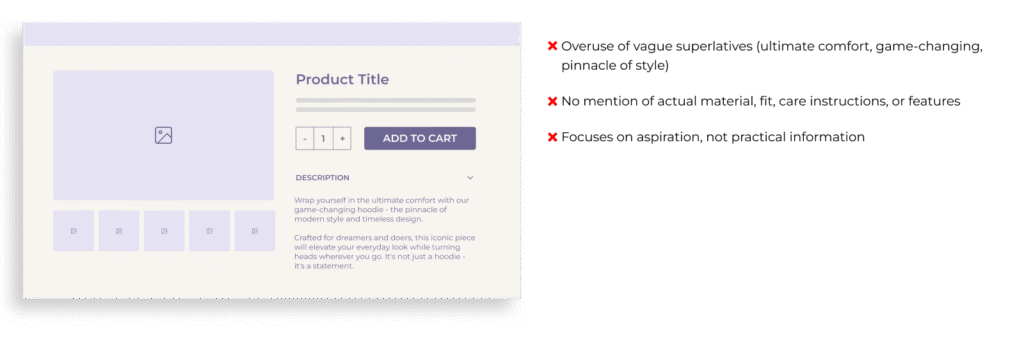
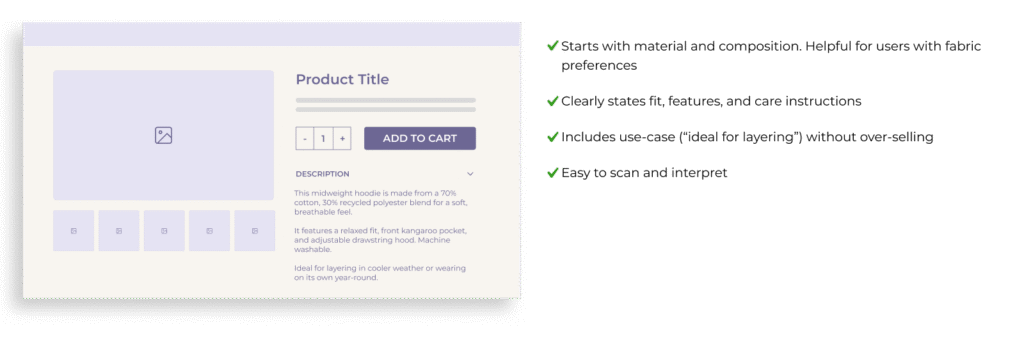
The difference between a persuasive yet informative product description and one that overwhelms with excessive marketing language is often subtle, but its impact on user behavior can be significant. Below are illustrative examples drawn from common e-commerce categories, followed by a brief comparative analysis to highlight what works and what doesn’t.
Example 1: Fashion Apparel
Overly Promotional Copy:
“Step into unparalleled luxury with this world-class cashmere sweater – a timeless masterpiece designed to elevate your wardrobe and turn heads wherever you go.”
Improved Copy:
“Made from 100% Grade A Mongolian cashmere, this sweater offers a soft, breathable feel ideal for cool weather. Ribbed cuffs and a classic crew neckline provide a clean fit suitable for both work and weekends.”
Why It Works:
The improved version delivers core information first: material, use case, and fit. It avoids vague adjectives and focuses on functional benefits, giving users a clear sense of what they are buying.
Example 2: Home Electronics
Overly Promotional Copy:
“This revolutionary soundbar brings cinema-quality audio into your living room like never before – the ultimate sound experience for audiophiles and home theater lovers.”
Improved Copy:
“This soundbar features Dolby Atmos® support and a 3.1 channel configuration for immersive surround sound. Includes HDMI eARC connectivity and wall-mount hardware for flexible setup.”
Why It Works:
By highlighting technical specifications and use-oriented features, the improved copy speaks directly to informed users evaluating compatibility and performance.
Example 3: Kitchen Appliances
Overly Promotional Copy:
“Transform your cooking experience with this must-have blender – designed to empower every culinary dream.”
Improved Copy:
“Equipped with a 1200W motor and stainless-steel blades, this blender handles everything from smoothies to nut butters. Dishwasher-safe components make cleanup fast and easy.”
Why It Works:
This revision removes vague aspirational language and replaces it with precise, functional details users can act on.
Comparative Takeaways
- Overuse of superlatives (“world-class,” “revolutionary”) tends to sound generic and offers little insight into product performance.
- Concrete, feature-based language builds clarity and confidence by addressing user intent directly.
- Descriptive context (e.g. “ideal for cool weather” or “compatible with HDMI eARC”) helps users mentally simulate use without relying on hype.
Implementation & Change Management
Recognizing the problem of excessive marketing copy is only the first step. Transforming product content at scale requires a deliberate, structured approach. Below are strategies to help product managers and e-commerce leads put these principles into practice.
1. Audit Existing Product Descriptions
Begin by evaluating your current product pages. Look for patterns of overuse: vague superlatives, missing specifications, or product claims buried beneath stylistic language. Flag content that lacks essential details or where key information is hard to locate. This audit should cover top-selling items, high-bounce pages, and representative examples from each product category.
2. Create Content Standards and Templates
Develop standardized templates that clearly separate functional details from optional marketing content. Define formatting rules for feature lists, required attributes, tone of voice, and how (or if) persuasive language should be used. Clear rules make it easier for content creators to be consistent and reduce the need for line-by-line editing.
3. Set Practical Editorial Guidelines
Establish guidelines that limit promotional language to specific areas (e.g., one paragraph maximum or a dedicated “highlight” box). Provide examples of both acceptable and excessive copy so writers, freelancers, and third-party vendors can calibrate appropriately. Include criteria for when to use emotional appeals and when not to.
4. Involve Cross-Functional Teams
Effective implementation requires alignment across UX, content, SEO, product, and marketing. Bring stakeholders together early to define shared goals: increasing user trust, reducing return rates, improving readability, and maintaining brand voice. This helps avoid resistance from teams who may see persuasive language with conversion potential.
5. Use Scalable Copy Management Tools
For large catalogs, manual editing isn’t practical. Consider content operations platforms or CMS plugins that allow for bulk editing, tag-based content organization, and automated flagging of stylistic patterns. Pair these tools with training for content creators to reduce friction over time.
6. Monitor Performance and Iterate
Establish KPIs for content clarity and effectiveness: conversion rate, add-to-cart behavior, bounce rate, and scroll depth. Supplement these with user feedback, usability testing, or live copy testing (A/B variants with and without promotional copy). Use findings to continuously refine content strategies.
7. Build Change Gradually
If large-scale changes risk disrupting existing workflows or marketing priorities, begin with a pilot. Choose a product category or a subsection of the catalog to test a cleaner, more structured approach. Measure the results, document the impact, and use the data to drive broader adoption.
Conclusion & Takeaways
The use of persuasive language in product descriptions is not inherently problematic. When applied with care and purpose, it can enrich the user experience and reinforce brand voice. However, when marketing copy dominates the page, it can undermine the very goals it seeks to achieve, causing users to lose trust, overlook critical information, or abandon the purchase altogether.
The most effective product descriptions are those that balance clarity with tone and detail with emotion. They provide immediate, scannable answers to practical questions while offering just enough stylistic framing to connect with the user. This balance is not accidental; it requires intentional content design, cross-functional alignment, and ongoing iteration based on user behavior and feedback.
For product managers and e-commerce leaders, improving product descriptions is a high-leverage opportunity. It influences user perception, impacts conversion, and reflects directly on brand credibility. By auditing existing content, establishing clear editorial standards, and grounding decisions in usability insights, teams can produce product pages that are more informative, more trustworthy, and ultimately more effective.
Key Implementation Points:
- Prioritize factual product details early in the description.
- Reserve persuasive or expressive language for separate, optional sections.
- Use consistent templates and plain language to improve scanability.
- Align content strategy across product, UX, and marketing teams.
- Continuously test and refine copy based on performance data and user feedback.