
Consumers are increasingly relying on visuals as critical trust signals that guide their buying decisions. Traditional manufacturer images present idealized products, elevating expectations but often failing to reflect day‑to‑day reality. Meanwhile, user-submitted review photos are helpful but limited in quantity and perspective.
Show social media visuals. Genuine, unfiltered views of how people use products in real situations. These visuals create a strong mix of familiarity and trustworthiness.
Recent data highlights the power of user‑generated content (UGC):
- Content showcasing real people using products on product pages increases conversions by 28%, while including video testimonials can drive an 80% uplift
- Another report finds that visitors engaging with UGC convert at a rate 102% higher than average
- UGC is 20% more influential than other media types in influencing millennial purchases, and when featured on product pages, it can boost conversions by up to 161%
Yet most sites still fall short. Reports say that 67% of product pages lack integrated social media visuals even when relevant. The disconnect between user expectations and execution creates a massive opportunity for brands to differentiate.
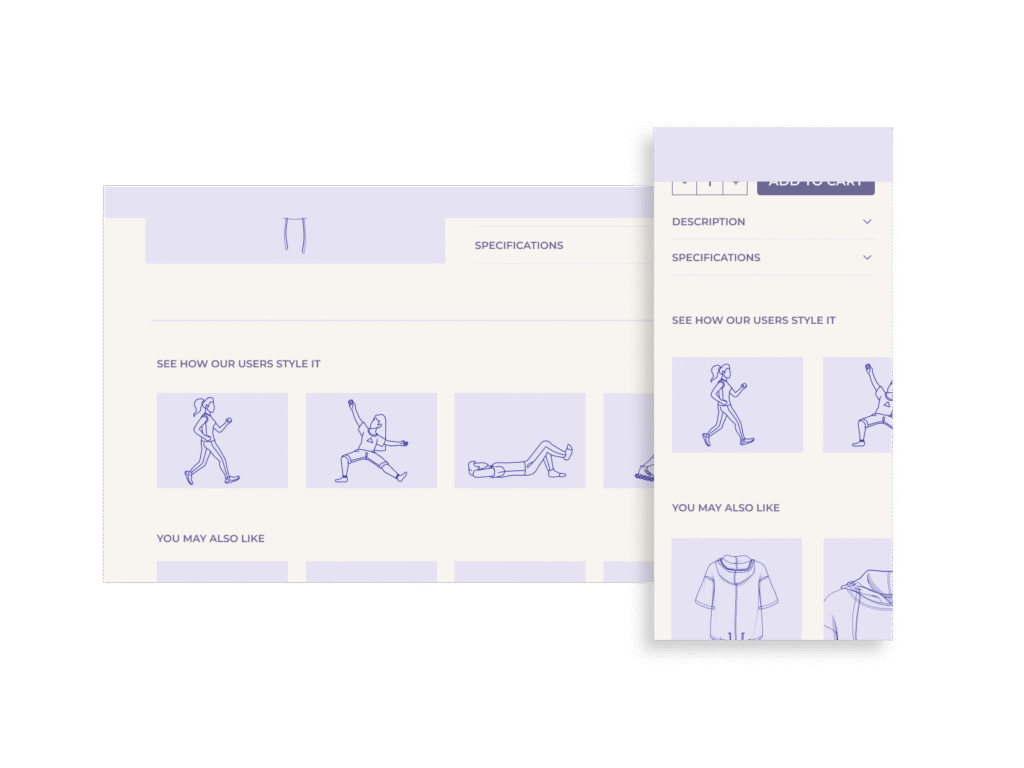
The Hierarchy of Visual Trust: Why Social Media Visuals Matter More Than Ever
Many product pages offer multiple visual modalities, but not all imagery is interpreted equally by users. Site-provided product images, while necessary, are often regarded as stylized or overly idealized. They are curated to highlight features, but rarely portray everyday use. Review-submitted photos (commonly embedded within customer reviews) provide valuable additional perspectives, but are often scattered, uncurated, and inconsistent in quality. Their role is supplementary, not central.
Social media visuals, by contrast, occupy a unique and increasingly critical tier in the visual trust hierarchy. Unlike reviewer photos, which users often discover only after scrolling through reviews, social media visuals are often surfaced near the product imagery itself, signaling prominence and intentionality. More importantly, they offer a window into how real users choose to present and interact with the product in their own lives.
Test participants reported disappointment when they could not find visual “social proof” in the form of real user content. This absence didn’t just reduce confidence. It triggered off-site information searching, as users turned to Instagram or TikTok to gather the visual validation that the product page failed to provide. Participants described social images as providing something neither manufacturer photos nor reviews could offer: a visual confirmation that someone like them had purchased, used, and enjoyed the product in a real-world context.
Importantly, these images are not interpreted as a replacement for site imagery or reviews, but as a third, distinct category of decision-making content. The image source itself fundamentally alters how users interpret the information. Social visuals are seen as inherently more spontaneous and therefore trustworthy, particularly when contrasted with influencer-style UGC or paid partnerships. Over-reliance on promotional posts risks diluting the perceived authenticity that makes these visuals effective in the first place.
Site Imagery vs. Reviews vs. Social Proof
| Visual Source | Strengths | Limitations | User Perception |
| Manufacturer / Brand Images | High-resolution, professional, controlled lighting and styling. Highlights features and product variants. | Often idealized; lacks real-world context; may create skepticism if too polished. | “Marketing content” – useful for understanding specs but not for measuring real use. |
| Review-Submitted Photos | Genuine, varied perspectives from actual buyers; adds credibility to written reviews. | Limited in volume; inconsistent quality; often buried within reviews, reducing visibility. | “Supplementary reassurance” – valuable but secondary to core product imagery. |
| Social Media Visuals | Authentic, candid, context-rich; reflects diverse real-world use cases; often aspirational. | Requires moderation; volume may vary by product; risks dilution if dominated by paid influencers. | “Authentic proof” – distinct category of content; directly boosts confidence and purchase intent. |
Evidence That Social Media Visuals Drive Conversions
Empirical evidence consistently highlights the impact of user-generated content (UGC), especially visual content, in boosting e-commerce performance. Across studies and real‑world experiments, the trend is consistent: when customers see real users interacting with products, trust and purchases go up.
Quantifying the Conversion Lift
A study analyzing interactions with user-generated imagery found that visitors who interacted with such visuals on product pages saw a 106% increase in conversion rates, up from a 91% lift the previous year. Specifically, engaging with UGC galleries )clicking on images or navigating between them) delivered particularly strong results, with conversion lifts exceeding 110%.
Beyond mere interaction, the presence of UGC also matters. Visitors exposed to any form of user content experienced an 8.5% lift in conversion, which nearly doubled to 100.6% when they engaged with it. This shows that even passive exposure has impact, while active engagement dramatically multiplies the effect.
In a more recent large‑scale analysis covering 1.5 million product pages across over 1,200 brands in 2022, PowerReviews found that simply serving up UGC led to a 3.8% uplift in conversions. Though smaller than interaction-driven lifts, it reinforces that visibility alone is valuable.
Case Study: The Tangible Impact of Visual UGC
In a creative A/B test, a retailer embedding customer photos into product pages reported a compelling 24% increase in checkout rate, equating to thousands in added revenue. Another UGC-driven intervention – for instance, displaying Instagram images on category pages – delivered a 13% lift in conversion, further validating the business value of authentic visuals.
Visuals Versus Text: The Engagement Edge
The power of visuals extends beyond UGC. Research shows that high-quality images boost purchase probability by 85%, while adding video to landing pages can deliver up to an 80% conversion rate increase. This strengthens the main argument: visuals grab attention and influence behavior in ways that text cannot.
User Psychology: Why Social Media Visuals Build Confidence
The measurable success of social media visuals on product pages is based on well-documented psychological principles of decision-making and trust. When shopping online, customers are not only evaluating functional product attributes, they are also engaging in a complex process of uncertainty reduction. Every click, scroll, or pause is shaped by the need to resolve a central question: “Can I trust this product to meet my expectations?” Social media visuals, more than any other form of content, help resolve this tension.
Authenticity Heuristics
Consumers instinctively differentiate between polished, branded imagery and candid, user-generated photos. Brand-provided visuals are processed as marketing content, while social visuals trigger what psychologists call authenticity heuristics – mental shortcuts that lead users to perceive a piece of information as more trustworthy because it appears unscripted and unmediated. Research into consumer psychology shows that authenticity is now one of the most important drivers of purchase intent, particularly for younger demographics who are deeply skeptical of traditional advertising formats.
The Power of Social Proof
Robert Cialdini’s principle of social proof explains much of this phenomenon. People tend to look to the behavior of others, especially those they perceive as peers, when forming decisions under uncertainty. Social media visuals tap directly into this instinct: they provide visible evidence that others like me not only bought the product but also enjoyed it enough to share it voluntarily. This dynamic transforms passive browsing into active reassurance, collapsing doubts that might otherwise result in cart abandonment.
Parasocial Influence
Equally important is the concept of parasocial influence – the one-sided psychological relationship people form with media figures, influencers, or even ordinary users they follow online. When shoppers encounter social visuals, they are not just seeing a product in abstract. They are seeing it through the lens of a trusted, familiar persona, whether it’s a micro-influencer or a friend-of-a-friend in their extended digital network. This relational dimension infuses the product with a sense of lived experience that brand images cannot replicate.
Information Foraging
Finally, social visuals satisfy the cognitive strategy known as information foraging, wherein users seek out diverse and emergent cues before committing to a purchase. Manufacturer photos cover predictable attributes: design, features, specifications. But customers crave unanticipated information, for example, how the fabric looks in natural light, how the furniture fits in a small apartment, or how a gadget performs after repeated use. Social media visuals provide exactly these accidental, context-rich cues, making them indispensable in the buyer’s decision-making journey.
Design & UX Best Practices for Integration
Integrating social media visuals on product pages is not simply a matter of inserting an Instagram feed or embedding a few TikTok clips. The placement, presentation, and labeling of these visuals all determine whether they build trust or create a distraction. Poor execution risks overwhelming the user, diluting the perception of authenticity, or even undermining the product narrative. Done correctly, however, social visuals become a seamless extension of the product page experience, reinforcing confidence and driving conversion.
Placement: Meeting Users Where They Look
Testing revealed that users expect social visuals to appear in close proximity to other product imagery. Placing them too low on the page, or burying them behind review sections, reduces visibility and diminishes impact. The strongest implementations place a curated carousel of social media photos directly beneath the primary image gallery or interwoven with official product shots. This placement signals equivalence in importance, communicating that these real-world visuals are as relevant as the brand’s own photography.
Shoppable Interactivity
Users respond especially well when social media images are clickable and shoppable, allowing them to tap into the original post or navigate directly to the featured product variant. This reduces friction in the path to purchase while adding credibility: the image is not an isolated asset, but part of a real person’s lived experience with the product. For multi-product images (such as outfits or home setups), interactive tags can further drive cross-sell opportunities.
Transparency Through Labeling
Authenticity is the currency of social media visuals. To protect it, brands must use clear labels that indicate the content source whether the post originated organically from a customer or came via a promotional collaboration. Users are quick to detect over-polished influencer campaigns masquerading as organic UGC, and when promotional content dominates a gallery, its persuasive value diminishes. A subtle tag such as “Shared by our community” or “Photo from Instagram” helps maintain trust without cluttering the visual flow.
Consistency Across Devices
Mobile-first design is critical. On smaller screens, social media visuals should appear as easily swipeable carousels, optimized for quick scanning. Thumbnail previews can reduce cognitive load, while modal enlargements allow for deeper exploration without breaking the page experience. Since over 70% of e-commerce traffic now originates on mobile, ensuring a fluid social visual experience across devices is foundational.
Avoiding the Pitfalls
Not all implementations succeed. Generic social feeds unrelated to the product in question distract rather than assist. Likewise, galleries that lack regular updates risk appearing stale, diminishing credibility. The best practice is to ensure product-specific feeds, updated dynamically, with clear fallback strategies (such as encouraging customers to share their own content) when no social visuals exist for a given product.
Operationalizing Social Visuals at Scale
While the benefits of social media visuals are clear, scaling their integration across hundreds or thousands of product pages presents a different challenge. To succeed, brands must not only create compelling user-generated content but also establish processes for sourcing, moderating, and maintaining this content without undermining authenticity or overwhelming internal teams. Effective operationalization ensures that social visuals remain a reliable, trust-building component of the product page, rather than a sporadic or inconsistent feature.
Aggregation and Technology Infrastructure
The first step in scaling social visuals is identifying tools that can automatically gather and create UGC from major platforms such as Instagram, TikTok, Pinterest, and YouTube. Solutions like Bazaarvoice, Pixlee TurnTo, Olapic, and Yotpo offer integrations that continuously pull in tagged content based on branded hashtags or direct product mentions. Automated pipelines ensure a steady inflow of fresh content, while API-driven systems allow this content to be displayed dynamically on relevant product pages.
Moderation and Brand Safety
Without moderation, brands risk displaying off-brand, inappropriate, or misleading content. Best practice involves a tiered moderation process: automated filters to detect inappropriate visuals (e.g., nudity, offensive symbols), combined with manual review for tone, brand alignment, and accuracy. Moderation should strike a balance – removing content that compromises trust, but avoiding over-polishing that undermines authenticity. Transparency tools, such as clearly labeling sponsored posts, further protect credibility.
Dynamic Population Rules
Not every product will have an abundance of social visuals. For items without sufficient user-generated content, brands should implement dynamic population rules. These may include:
- Hybrid galleries: Mixing authentic customer photos with carefully selected influencer content, clearly labeled, to maintain volume without diluting transparency.
- Cross-promotion: Displaying social visuals from similar or related products when direct matches are unavailable.
- Fallback messaging: Transforming empty galleries into engagement opportunities with CTAs such as “Be the first to share your photo with #MyBrandStyle”.
Incentivizing Content Creation
Scaling also depends on feeding the pipeline. Brands can incentivize customers to generate more visuals through rewards programs, contests, and recognition campaigns. Even subtle nudges like follow-up emails requesting tagged Instagram posts in exchange for discounts or featuring customer content on official channels encourage a steady flow of usable visuals. Crucially, incentives must be designed to encourage participation without creating a sense of inauthenticity.
Measurement and Iteration
Finally, operational success requires ongoing performance tracking. Brands should monitor not only engagement metrics (clicks, interactions, time-on-page) but also conversion outcomes tied specifically to UGC exposure. Advanced analytics can reveal whether certain types of visuals (e.g., lifestyle shots vs. product close-ups, video vs. photo) deliver superior results. These insights should feed back into both moderation criteria and content sourcing strategies, creating a continuous cycle of optimization.
Future-Proofing for Emerging Formats
The rapid evolution of social platforms and content formats means that today’s best practices may quickly become tomorrow’s table stakes. Forward-thinking e-commerce leaders must not only implement social visuals as they exist today but also anticipate how shifts in consumer behavior, platform dominance, and content authenticity will reshape the field. Future-proofing requires adaptability, technological flexibility, and a nuanced understanding of where digital culture is headed.
The Rise of Short-Form Video
Static imagery is powerful, but the center of gravity in social media has shifted decisively toward short-form video. Platforms like TikTok, Instagram Reels, and YouTube Shorts dominate consumer attention spans, and their influence extends directly into commerce. According to research from HubSpot, 73% of consumers prefer short-form video when learning about a product, and these formats are twice as likely to drive purchases compared to static content. Product pages that integrate short-form video (especially authentic clips created by real users) will increasingly outperform static-image-only approaches.
Authenticity in the Age of AI
Generative AI introduces a paradox. On one hand, it enables brands to scale the production of lifestyle visuals and videos at unprecedented speed. On the other hand, consumers are becoming increasingly skeptical of content that feels too polished, fearing it may be artificial. In fact, Gartner predicts that by 2026, 80% of consumers will prioritize “authentic” experiences over synthetic ones. The challenge for brands will be to leverage AI as a supplement – for example, to enhance creation or personalize galleries – without allowing it to displace the raw authenticity that defines the value of social visuals. Transparency markers, such as “AI-assisted” labels, may become essential.
Platform Fluidity and Consumer Shifts
While Instagram and TikTok currently dominate the space, platform dominance is inherently unstable. BeReal has shown the appetite for raw, unfiltered sharing; Pinterest continues to influence discovery through aspirational boards; and new platforms like Threads or decentralized social networks could redefine how users express themselves visually. To remain adaptable, brands must build modular integration frameworks that can ingest and display content regardless of its platform of origin. API-driven, platform-agnostic systems are more sustainable than one-off integrations tied to a single network.
Beyond the Product Page
Future-proofing also means recognizing that the product page may no longer be the only (or even the primary) arena for visual persuasion. Shoppable video feeds, AR product placements, and immersive virtual storefronts are blurring the lines between social platforms and e-commerce sites. The most resilient brands will adopt a “distributed commerce” mindset, ensuring that social visuals flow seamlessly between owned channels, social platforms, and retail partner sites, creating a unified visual trust layer across the entire customer journey.
Counterarguments & Strategic Responses
Despite the evidence for integrating social media visuals, some brands remain hesitant. Their concerns typically center on content availability, aesthetic control, and risk management. These are legitimate considerations, but none outweigh the strategic upside of embedding social visuals on product pages. More importantly, each concern can be addressed with clear, practical responses.
“What if we don’t have enough social content?”
This is a common challenge, especially for new products or niche categories. However, an initial lack of content should not justify inaction. Instead, brands can transform this absence into an opportunity by displaying dynamic placeholders inviting customers to share their own photos or videos with a branded hashtag. Far from being perceived as a gap, this approach reframes the lack of visuals as a community-building exercise. Incentives, such as discounts or feature spotlights, can accelerate the pipeline. Over time, even a small stream of organic content can grow into a robust gallery.
“What if user photos don’t match our brand aesthetic?”
Some marketers fear that raw, candid visuals will clash with carefully curated brand photography. Yet this tension is precisely what makes social visuals persuasive. Research shows that overly polished UGC loses credibility, as consumers interpret it as another form of advertising. The solution is balance: allow genuine, varied content to surface while applying light-touch moderation to filter out content that is misleading or inconsistent with core brand values. The juxtaposition of polished brand imagery and authentic user visuals creates a more complete and more trustworthy story.
“What about moderation risks?”
Brands worry about inappropriate content slipping through. While this is a valid concern, modern aggregation platforms combine automated filtering with human review to minimize risk. AI systems can flag nudity, offensive symbols, or competitor products, while human oversight ensures context-appropriate curation. Importantly, moderation policies should be transparent: brands should avoid erasing every imperfection, as small flaws often reinforce authenticity. The goal is not perfection, but credible representation.
“Doesn’t this create clutter or distract from the main purchase path?”
On the contrary, when strategically placed, social visuals reduce friction. Rather than forcing users to leave the site and forage on external platforms, embedded galleries concentrate attention within the product page. Well-designed carousels, especially when product-specific, integrate seamlessly with the purchase flow. As testing demonstrated, distraction occurs primarily when generic social feeds are displayed in place of product-relevant content. The key is product specificity, ensuring that every visual relates directly to the item under consideration.
Conclusion
Social media visuals are no longer just nice to have. Customers have grown accustomed to validating purchases through the lens of real people, in real contexts, outside of brand-controlled environments. When product pages fail to provide these signals, users go elsewhere to find them. Too often, this off-site foraging results not in a return visit, but in an abandoned cart or a competitor’s sale.
Usability research highlights the emotional gap left by their absence, while empirical studies confirm the measurable lift in conversion when they are present. At the psychological level, these visuals activate trust mechanisms that cannot be replicated by studio photography or written reviews alone. At the operational level, scalable technologies and moderation frameworks make their implementation both feasible and sustainable across entire catalogs.
The trajectory of digital commerce makes the case even stronger. As short-form video eclipses static imagery and new social platforms continue to shape discovery, the integration of authentic, user-driven visuals will only grow in strategic importance. Far from being a trend, this is a structural shift in how consumers make purchase decisions.
Implementation Checklist: Embedding Social Media Visuals Effectively
Step 1: Audit and Gap Analysis
- Review existing product pages to identify which ones lack visual social proof.
- Compare with competitor pages and external platforms to see where customers are already posting about your products.
Step 2: Select Aggregation Tools
- Choose a UGC aggregation platform (e.g., Bazaarvoice, Pixlee, Yotpo) that integrates with your CMS or eCommerce stack.
- Prioritize solutions that support multiple content types (images, video, short-form reels) and allow dynamic population by product.
Step 3: Define Moderation Policies
- Set clear rules for what qualifies as acceptable UGC.
- Implement automated filters for inappropriate content, supported by human review for nuance and brand alignment.
- Label sponsored or influencer content transparently to preserve trust.
Step 4: Design and Placement
- Place social visuals near the primary product gallery to signal importance.
- Optimize for mobile-first consumption with swipeable carousels and tap-to-expand modals.
- Enable shoppable tagging for multi-product images to encourage cross-sells.
Step 5: Incentivize User Contributions
- Launch branded hashtag campaigns to encourage customer submissions.
- Offer small rewards (discount codes, loyalty points, social recognition) to motivate participation.
- Follow up post-purchase with automated requests for tagged photos or short video clips.
Step 6: Monitor and Optimize
- Track engagement metrics (clicks, time-on-page, shares) and correlate them with conversion rates.
- Test variations: video versus photo, lifestyle versus close-up, gallery placement above versus below the fold.
- Iterate based on performance insights to continuously refine the approach.